SockJS support for Node.js
Introduction
SockJS is a browser/server communication framework designed to provide a WebSocket-like programming model when native WebSocket support is unavailable or unreliable.
This extension supports the server side and the client side of the following SockJS libraries:
- sockjs — SockJS server implementation
- sockjs-client — SockJS client implementation
Objects
| Metamodel name | Description |
|---|---|
CAST_NodeJS_WebSocket_Server |
Represents a WebSocket server endpoint identified by its path |
CAST_NodeJS_WebSocket_Client |
Represents a WebSocket client entrypoint identified by its path |
A NodeJS WebSocket Server object is created as soon as the server is instantiated
(sockjs.createServer(...)), even if no handler is ever registered on it
and it never sends any data. A server is named {} when its path cannot be statically determined
(for example when the path is passed as a runtime parameter). A server named {} is treated as a catch-all endpoint.
A NodeJS WebSocket Client object is created as soon as the client is instantiated
(new SockJS(...)), even if no handler is ever registered on it
and it never sends any data. A client is named {} when its path cannot be statically determined
(for example when the path is passed as a runtime parameter).
Links
| Link type | From | To | Created when |
|---|---|---|---|
callLink |
NodeJS WebSocket Server | NodeJS Function / Method | A handler is registered on the server (on('connection', ...), on('data', ...), on('close', ...), on('end', ...), on('error', ...)) |
callLink |
NodeJS Function / Method | NodeJS WebSocket Server | A function sends a message to clients (broadcast) or calls .send() from outside a registered handler — see filtering rule below |
callLink |
NodeJS WebSocket Client | NodeJS Function / Method | A handler is registered on the server (onopen, onmessage, onclose, onerror) |
callLink |
NodeJS Function / Method | NodeJS WebSocket Client | A function iniatiates a connection to a server |
Supported API methods
sockjs package
| API method | Object created / linked | Link type |
|---|---|---|
sockjs.createServer(options) |
NodeJS WebSocket Server | — |
server.on(event, handler), also once and addEventListener |
fn linked as callee of server | callLink |
conn.write(...) / conn.send(...) called from a registered handler |
Calling function → NodeJS WebSocket Server | — |
sockjs-client package or the browser global SockJS
| API method | Object created / linked | Link type |
|---|---|---|
new SockJS(url, ...) |
NodeJS WebSocket Client | — |
sock.onopen = handler |
fn linked as callee of client | callLink |
sock.onmessage = handler |
fn linked as callee of client | callLink |
sock.onclose = handler |
fn linked as callee of client | callLink |
sock.onerror = handler |
fn linked as callee of client | callLink |
sock.send(...) / sock.write(...) |
Calling function → NodeJS WebSocket Client | — |
Example
sockjs and sockjs-client
const http = require('http');
const path = require('path');
const express = require('express');
const sockjs = require('sockjs');

const app = express();
app.use(express.static(path.join(__dirname, 'public')));

const clients = new Set();

const sjs = sockjs.createServer({
  prefix: '/socket',
  websocket: true,
  heartbeat_delay: 10000,   // short, so you can actually watch 'h' frames arrive
  disconnect_delay: 5000,
  log: (sev, msg) => { if (sev !== 'debug') console.log(`[sockjs:${sev}] ${msg}`); },
});
const SockJS = require('sockjs-client');
const WebSocket = require('ws');

const BASE = 'http://localhost:3000/socket';

function viaSockJS() {
  return new Promise((resolve) => {
    console.log('\n=== A. sockjs-client ===');
    const sock = new SockJS(BASE, null, { transports: ['websocket'] });

    sock.onopen = () => {
      console.log(`open  transport=${sock.transport}`);
      console.log(`url   ${sock.url}`);
      sock.send(JSON.stringify({ type: 'echo', text: 'from sockjs-client' }));
      setTimeout(() => sock.close(), 800);
    };
    sock.onmessage = (e) => console.log('msg  ', e.data);
    sock.onclose = (e) => { console.log(`close code=${e.code}`); resolve(); };
  });
}
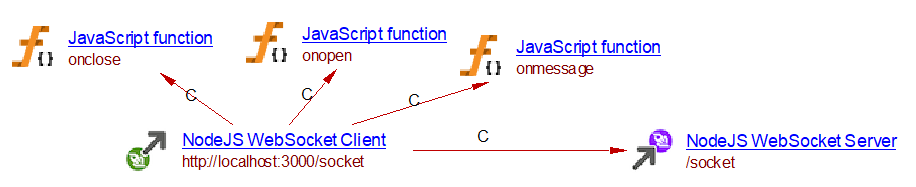
This produces:
- one
NodeJS WebSocket Serverobject named/socket - one
NodeJS WebSocket Clientobject namedhttp://localhost:3000/socket - a
callLinkfromNodeJS WebSocket Clienttoonopen - a
callLinkfromNodeJS WebSocket Clienttoonmessage - a
callLinkfromNodeJS WebSocket Clienttoonclose
Assuming that the websocket client connects to the websocket server, you will get the following result: