Node.js - Axios for Nest support
Introduction
The Axios module for Nest was originally published as part of the @nestjs/common package. This package is a drop-in replacement for the deprecated HttpModule - see https://docs.nestjs.com/techniques/http-module for more information.
Objects
This extension creates the service objects:
- a
NodeJS Delete HttpRequest serviceobject when thedeleteAPI of aHttpServiceis found; - a
NodeJS Get HttpRequest serviceobject when thegetorheadAPIs of aHttpServiceis found; - a
NodeJS Post HttpRequest serviceobject when thepostAPI of aHttpServiceis found; - a
NodeJS Put HttpRequest serviceobject when theputAPI of aHttpServiceis found; - a
NodeJS Patch HttpRequest serviceobject when thepatchAPI of aHttpServiceis found.
The request API of a HttpService can create four service objects above corresponding the APIs found
in its arguments: delete, get, head, post, patch, put.
If any API is not found, a NodeJS Get HttpRequest service object is created by default.
| Icon | Description |
|---|---|
 |
NodeJS Delete HttpRequest service |
 |
NodeJS Get HttpRequest service |
 |
NodeJS Post HttpRequest service |
 |
NodeJS Put HttpRequest service |
|
NodeJS Patch HttpRequest service |
Supported links
| Link type | Caller type | Callee type |
|---|---|---|
| callLink |
|
|
Example
Take the following codes:
import { HttpService } from '@nestjs/axios';
import { Injectable } from '@nestjs/common';
import { Observable } from 'rxjs';
import { map } from 'rxjs/operators';
import { AxiosResponse } from 'axios';

@Injectable()
export class CatsService {
  constructor(private httpService: HttpService) {}

  create(createCatDto: CreateCatDto): Observable<AxiosResponse<any>> {
    return this.httpService
      .post('http://localhost:3000/cats', createCatDto)
      .pipe(map((response) => response.data));
  }

  findAll(): Observable<AxiosResponse<Cat[]>> {
    return this.httpService
      .get('http://localhost:3000/cats')
      .pipe(map((response) => response.data));
  }

  findOne(id: number): Observable<AxiosResponse<Cat>> {
    return this.httpService
      .get(`http://localhost:3000/cats/${id}`)
      .pipe(map((response) => response.data));
  }

  update(id: number, updateCatDto: UpdateCatDto): Observable<AxiosResponse<Cat>> {
    return this.httpService
      .put(`http://localhost:3000/cats/${id}`, updateCatDto)
      .pipe(map((response) => response.data));
  }

  patch(id: number, patchCatDto: Partial<UpdateCatDto>): Observable<AxiosResponse<Cat>> {
    return this.httpService
      .patch(`http://localhost:3000/cats/${id}`, patchCatDto)
      .pipe(map((response) => response.data));
  }

  remove(id: number): Observable<AxiosResponse<void>> {
    return this.httpService
      .delete(`http://localhost:3000/cats/${id}`)
      .pipe(map((response) => response.data));
  }
}
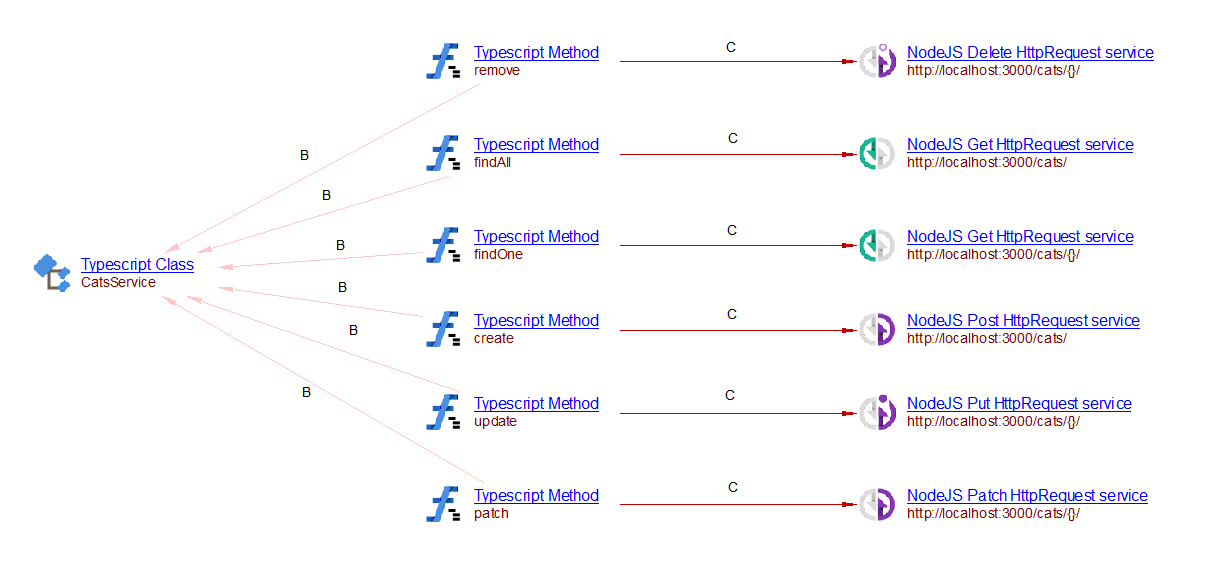
In this example, six service objects are created, and six callLink are also added between these objects and TypeScript methods corresponding.