SQL Analyzer - 3.8
Description
The SQL Analyzer provides support for database technologies using the ANSI SQL-92/99 language. This extension uses the Universal Analyzer framework and is intended to analyse DDL, DML and SQL exports for a large variety of SQL variants:
- This extension provides source code analysis support for DDL and DML source files using an over language of the various SQL variants.
- See Supported File Extensions below for the list of supported files.
In what situation should you install this extension?
- If you need to analyze the SQL server part compliant with ANSI SQL-92 / 99 of your client/server application
Supported file extensions
The following table summarizes the source file extensions managed by the SQL Analyzer by default. Other file extensions could be used, upon manual configuration (within CAST Console). You can also have a look to Database File Discovererin order to understand which one of the file extensions are taken in account when a SQL project is added.
File |
Extension |
Mandatory/Optional | Note |
|---|---|---|---|
| SQL source files | .sql .sqlt .ddl .dml .plsql .pgsql .mysql |
Mandatory |
DDL / DML files You should deliver at least one of the listed extensions.
|
| CAST generated Files | .uaxdirectory .src |
.src files are SQL sources files generated with CAST Database Extractor. Supported for compatibility reasons only. |
|
| IBM Db2 for i Logical File | .lf .lf38 |
IBM Db2 for i View in DDS format | |
| IBM Db2 for i Physical File | .pf .pf38 |
IBM Db2 for i Table in DDS format | |
| CAST SQL Table Size File | .sqltablesize | Optional | See SQL Analyzer - working with XXL or XXS tables. |
| CAST Data Sensitive File | .datasensitive | Optional | See SQL Analyzer - RDBMS Table Sensitive Data. |
| Additional SQL source files | .bdy .db2 .fnc .pck .pkb .pkg .pks .plb .pls .spc .tab .tpb .tps .trg .trigddl .tsql .udf .viewddl .viw .vw |
Optional | DDL files Those files are not recognised by Database File Discoverer but if you have at least one mandatory file in the analysis root folder, the SQL Analyzer will analyze them. |
Unsupported files extensions
Some other file extensions could potentially have SQL statements, e.g. : *.inc, *.prc or *.vue. The product is matching them with PHP language for *.inc, JCL language for *.prc and VueJS for *.vue. That’s why they are not listed above. If you’re sure they contains valuable SQL statements, simply change the extension from inc/prc/vue to sql.
Vendor compatibility matrix - official support
| Icon | Vendor | Version | Supported? |
|---|---|---|---|
|
IBM Db2 for LUW | Up to version 11.x |
 |
|
IBM Db2 for z/OS | Up to version 12 | |
|
IBM Db2 for i | Up to version 7.5 | |
|
IBM Informix | Up to version 14.x | |
|
MariaDB | Up to version 10.x | |
|
Microsoft SQL Server | Up to version 2022 | |
|
MySQL | Up to version 8.x | |
|
Oracle Server | Up to version 23ai | |
|
PostgreSQL | Up to version 17.x | |
|
SAP ASE (formerly known as Sybase ASE) | Up to version 16 | |
|
SQLite | Up to version 3.x | |
|
Teradata | Up to version 16 | |
|
CockroachDB | Up to version 24 | |
|
NonStop SQL | Up to version 3.x | |
|
Ingres / Actian | Up to version 12.x | |











Transactions
Transaction support is derived from metamodel concepts used to build CAST Imaging Blueprint and structural transaction flows. Entry Points start transactions; Exit Points include both output/boundary concepts and Data Entities manipulated by transactions.
| Role | Support | Breakdown |
|---|---|---|
| Entry Point | No direct concept type details | |
| Exit Point |
Data Entity with Accurate FP
|
Data version: 3.8.3-funcrel
ISO 5055 Structural Rules
Quality support is based on ISO 5055 structural rules available for the selected extension version.
| Reliability | Maintainability | Security | Performance Efficiency |
|---|---|---|---|
Data version: 3.8.3-funcrel
What results can you expect?
Objects
See detail about how the system objects are determined here : SQL Analyzer - System Object.
| Type | Name | Description |
|---|---|---|
 |
Event | Created from CREATE EVENT statements. |
|
System Event | Represents an event identified as a system event. |
 |
DML Script File | Created for files containing DML statements such as INSERT, LOAD, UPDATE, DELETE, and SELECT. Candidates containing more than 80% INSERT statements are considered data exports and are not analyzed. Files mixing DML and DDL statements can be considered both DML and DDL scripts. |
 |
Macro | Created from CREATE MACRO statements. |
|
System Macro | Represents a macro identified as a system macro. |
 |
Package | Created from CREATE PACKAGE and CREATE PACKAGE BODY statements. |
 |
System Package | Represents a package identified as a system package. |
 |
SQL Call to C/C++ Function | A SQL Call to a C/C++ Function that will be executed when the Procedure / Function is called. Added for a Procedure / Function implemented in C/C++. |
 |
SQL Call to Java Method | A SQL Call to a Java Method that will be executed when the Procedure / Function is called. Added for a Procedure / Function implemented in Java. |
|
SQL Call to Program | A SQL Call to a Cobol/RPG400/RPG300/CL400/Assembler/Rexx program or a PLI/PLC MainProcedure that will be executed when the Procedure / Function is called. Added for a Procedure / Function implemented in Cobol (language COBOL/COBOLLE), RPG IV (language RPGLE), RPG III (language RPG), CL IV (language CL), PL/I (language PLI), Assembler (language ASSEMBLE). |
 |
System Table Column | Represents a column belonging to a system table or system view. |
|
Table Column | Created for columns detected in CREATE TABLE statements. For CREATE VIEW statements, only aliases assigned to selected expressions are considered column names. |
 |
Function | Created from CREATE FUNCTION statements. This type also represents functions declared inside packages. |
|
Method | Represents a method declared by an SQL object type. |
 |
System Function | Represents a standalone or packaged function identified as a system function. |
|
System Method | Represents a method belonging to a system SQL object type. |
 |
Unresolved Object | Created when a procedure-like or function-like object accessed through a database link cannot be resolved in the analysis results. |
 |
Index | Created from CREATE INDEX statements. |
|
System Index | Represents an index belonging to a system table. |
 |
Foreign Key | Created from foreign-key definitions in CREATE TABLE or ALTER TABLE statements. |
|
System Foreign Key | Represents a foreign-key constraint belonging to a system table. |
 |
System Unique Constraint | Represents a unique or primary-key constraint belonging to a system table. |
|
Unique Constraint | Created from CREATE UNIQUE INDEX or primary-key statements. Tables are marked as having a primary key when appropriate. Keys in .pf and .pf38 files are created for the Db2 for i variant, using the file name prefixed with PK_. |
 |
SQL Missing Procedure | A procedure or a function called in a View / Trigger / Event / Macro / Procedure / Function / Method / DML Script file missing from the DDL file. |
 |
Procedure | Created from CREATE PROCEDURE and REPLACE PROCEDURE statements. This type also represents procedures declared inside packages. |
|
System Procedure | Represents a standalone or packaged procedure identified as a system procedure. |
 |
SQL Missing Schema | Created as the parent of a missing table or missing procedure when its schema cannot be resolved. |
 |
Schema | Created for schemas detected in all supported RDBMS. See SQL Analyzer - How object identity is determined for details about how the schema is determined. |
|
System Schema | Represents a schema identified as a system schema in a supported RDBMS. It can contain system tables, views, and other system objects. |
|
Unresolved Schema | Created as the parent of unresolved tables and unresolved procedure-like objects accessed through a database link. See SQL Analyzer - How object identity is determined for an example. |
 |
Database | Created for MS SQL Server, ASE Sybase, IBM Db2, CockroachDB, and NonStop SQL. See SQL Analyzer - How object identity is determined for details about how the database is determined. |
|
System Database | Represents a database identified as a system database for MS SQL Server, ASE Sybase, IBM Db2, CockroachDB, or NonStop SQL. |
 |
SQL Missing Table | Created when a table or view referenced by a view, trigger, event, macro, procedure, function, method, or DML script is missing from the analyzed DDL files. |
 |
Synonym | Created from CREATE SYNONYM, CREATE ALIAS, CREATE SQLMP ALIAS, and CREATE NICKNAME statements. |
 |
System Table | Represents a table identified as a system table in the analyzed database. |
|
Table | Created from CREATE TABLE statements. Records in .pf and .pf38 files are also created as tables for the Db2 for i variant, using the file name as the table name. |
|
Unresolved Table | Created when a table-like object accessed through a database link cannot be resolved in the analysis results. |
 |
System Trigger | Represents a trigger identified as a system trigger. |
|
Trigger | Created from CREATE TRIGGER and CREATE RULE statements. |
 |
System View | Represents a view identified as a system view in the analyzed database. |
|
View | Created from CREATE VIEW and REPLACE VIEW statements. Records in .lf and .lf38 files are also created as views for the Db2 for i variant, using the file name as the view name. |
 |
Database Link | Created from CREATE DATABASE LINK statements. |
|
System Database Link | Represents a database link identified as a system database link. |
|
System Synonym | Represents a synonym, alias, or nickname identified as a system object. |
 |
System Type | Represents a user-defined type identified as a system type. |
|
Type | Created from CREATE TYPE and CREATE TYPE BODY statements. |
 |
sourceFile | Logical file created for each analyzed source file. It includes a Vendor property identifying the SQL variant used for analysis. See SQL file Vendor - This file is analyzed against XXX variant. |
Table deletion and renaming
DROP TABLE syntax is supported for table objects within the same file. When creating a table through CREATE TABLE tableName (colName int, …) followed by a DROP TABLE tableName, the table will not be recorded and thus will not be displayed in CAST Enlighten. When a table is dropped, its indexes are dropped as well. Similarly, if a table is renamed with a RENAME TABLE statement (or ALTER TABLE RENAME TO as in SQLite and PostgreSQL), this change will be reflected in CAST Enlighten. Presently we consider case-insensitive names, i.e., objects named tableName, TABLEname are considered to be the same object.
Links
Links are created for transaction and function point needs.
First table is for SQL objects created in SQL files and we call them server side links. The second is for queries from the different client languages and we call them client server links.
Server side links
| Link Type | Caller type | Callee type | Details / Comments |
|---|---|---|---|
| useSelect, useUpdate, useDelete, useInsert | Procedure Function Macro Event View DML Script File |
Table View Synonym SQL Missing Table |
|
| callLink | Procedure Function Event Macro View DML Script File |
Procedure Function Synonym SQL Missing Procedure |
|
| callLink | Method’s Type | Method’s Type | When an PL/SQL object’s method is called indirectly, via a variable. |
| callLink | Procedure, Function | SQL Call to Program | |
| callLink | Procedure, Function | SQL Call to Java Method | |
| callLink | Procedure, Function | SQL Call to C/C++ Function | |
| callLink | Trigger | Procedure Function |
when table is INSERTED, UPDATED, DELETED in a Procedure, Function we add a call link between the Procedure, Function and the Trigger. |
| relyonLink | Index | Table | |
| relyonLink | Index | Index’s Column | |
| relyonLink | Synonym | Table View Function Procedure Package |
|
| relyonLink | Type’s Method / Function / Procedure | Type Table |
When parameter/variable datatypes are PL/SQL Type/Table Columns. |
| referLink | Table, Table Column | Table Table Column |
From a Table/Table Column to a Table/Table Column referenced in a Foreign Key. |
| referUpdate | Table | Table | From a Table to the Table referenced in a Column referenced in a Foreign Key. |
| referDelete | Table | Table | From a Table to the Table referenced in a Column referenced in a Foreign Key: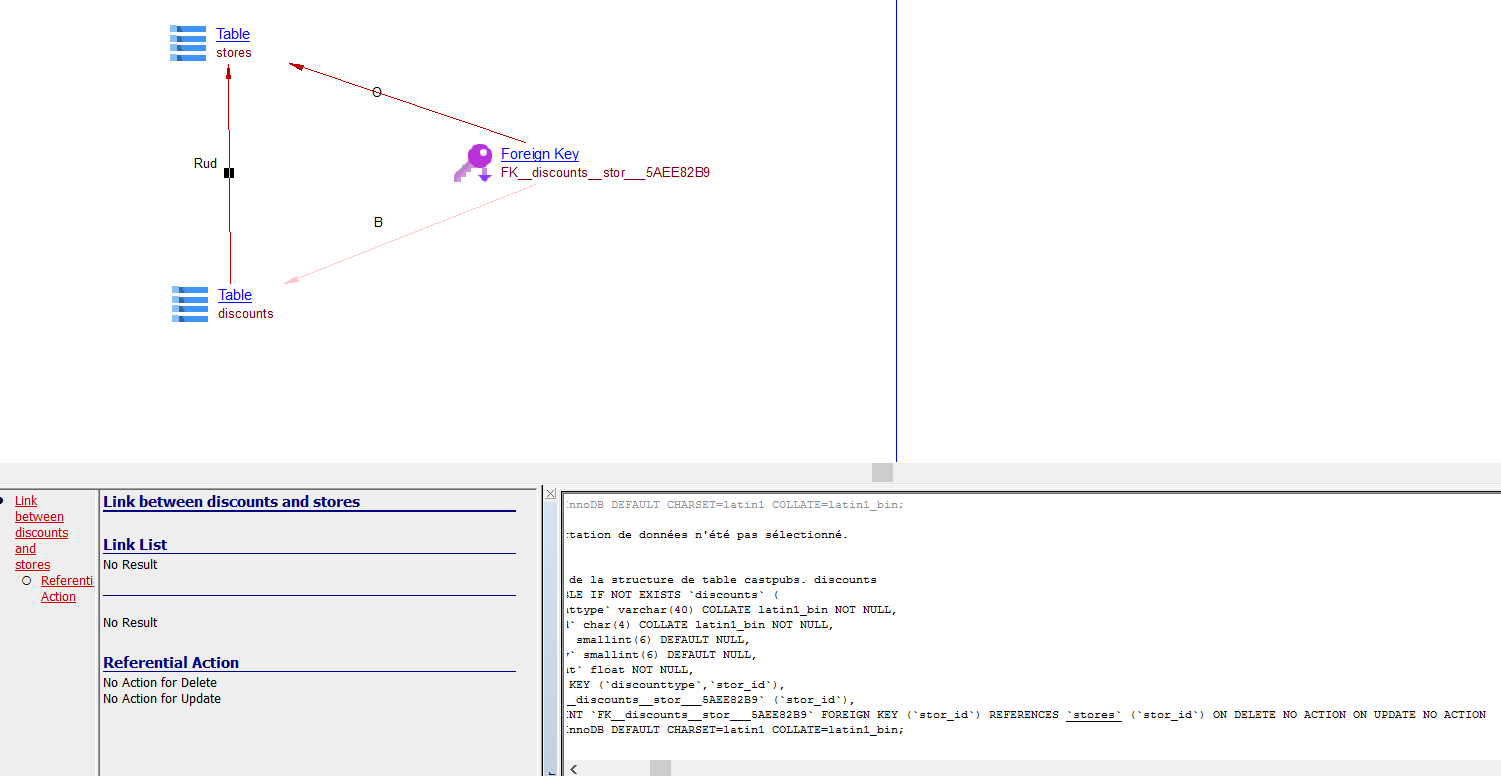 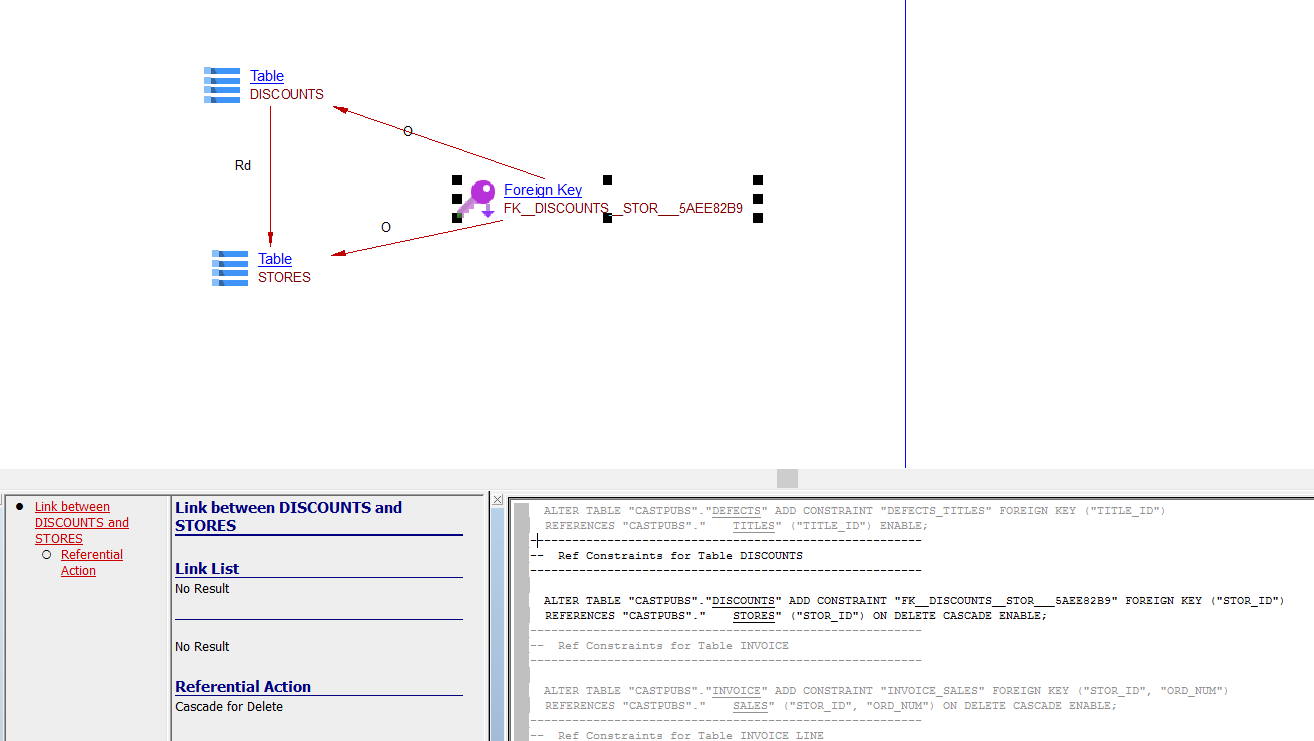 |
| callLink | DML Script File, SQL Query | Trigger | Call the Trigger when the tables are inserted/updated/deleted: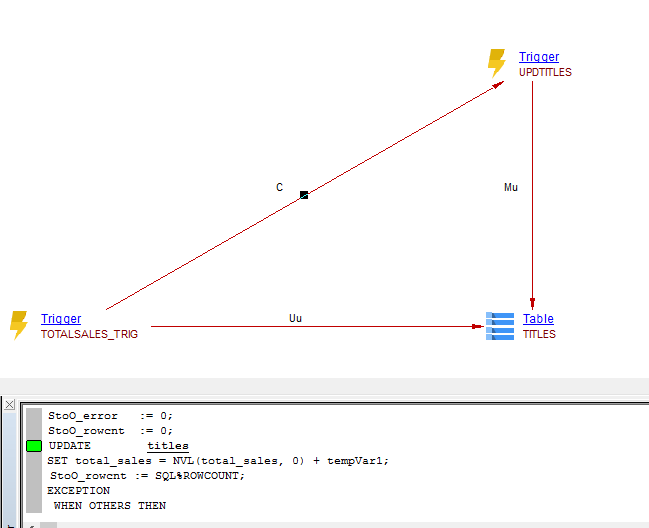 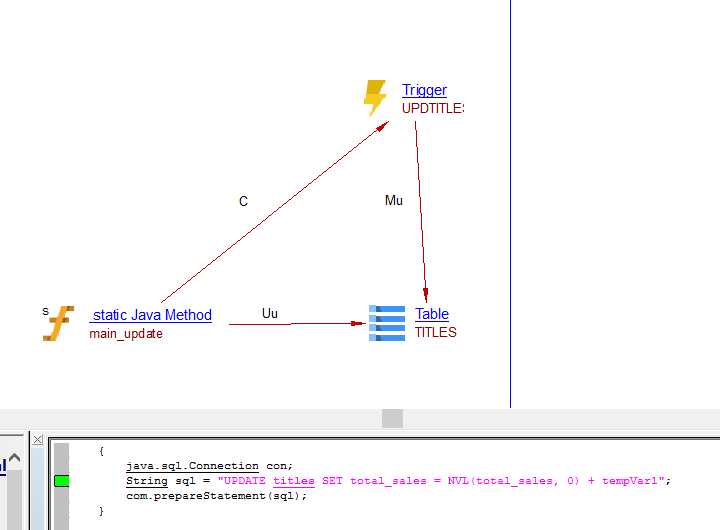 |
| inheritExtendLink | sub Type | super Type | For PL/SQL Types. |
| inheritOverrideLink | Method Type | Method Type | From a PL/SQL Method’s Type which override a super Type’s Method. |
| useLink | Type | Type | For PL/SQL tables, example:CREATE OR REPLACE TYPE "CNCUBLIST_2" is table of "HIS_TEST_A";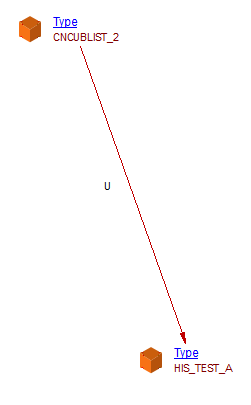 |
| monitorInsert, monitorUpdate, monitorDelete | Trigger | Table View |
| Links Created by Universal Linker | ||
|---|---|---|
| Link Type | Caller type | Callee type |
| callLink | SQL Call to Program | A Cobol/RPG400/RPG300/CL400/Assembler/Rexx program or a PLI/PLC MainProcedure |
| callLink | SQL Call to Java Method | A Java Method |
| callLink | SQL Call to C/C++ Function | A C/C++ Function |
Client server links
SQL Analyzer is responsible to create the following client server links for the embedded SQL supported by Analyzers and extensions, that is through SQL Query and Entity / Entity Operations intermediate objects. This is the case of JDBC, JPA / Hibernate, EF, Ado.net, Dapper, Embeded SQL in COBOL, Pro*C, Python, Shell, NodeJS, Oracle Forms and Reports, etc.
| Link Type | Caller type | Callee type | Details / Comments |
|---|---|---|---|
| useSelect, useUpdate, useDelete, useInsert | SQL Query, Java Property Mapping, Entity Operation |
Table View Synonym SQL Missing Table |
SQL Query is a Client SQL Query, having the icon  . A Java Property Mapping is property similar to a SQL statement. Java Property object icon is  . Entity Operations are client objects like JPA Entity Operation, NodeJS Entity Operation, etc. If a table is selected in the Cobol / RPG SQL Query DECLARE C1 CURSOR we consider it is selected in the Cobol SQL Query FETCH C1. |
| callLink | SQL Query, Java Property Mapping |
Procedure Function Macro Synonym SQL Missing Procedure |
|
| callLink | Trigger | SQL Query, Java Property Mapping |
When table is INSERTED, UPDATED, DELETED in a SQL Query, Java Property Mapping we add a call link between the SQL Query, Java Property Mapping and the Trigger. |
| useSelect, useUpdate, useDelete, useInsert | IMS SQL Query | IMS DB Segment | |
| monitorInsert, monitorUpdate, monitorDelete | Oracle Forms Trigger | Table View |
|
| ddlCreateLink | SQL Query |
Table SQL Embedded Table |
For CREATE TABLE statements |
| ddlAlterLink | SQL Query |
Table SQL Embedded Table |
For ALTER TABLE statements |
| ddlReplaceLink | SQL Query |
Table SQL Embedded Table |
For REPLACE TABLE statements |
| ddlDropLink | SQL Query |
Table SQL Embedded Table |
For DROP TABLE statements |
| ddlLink | SQL Query |
Table SQL Embedded Table |
For DECLARE TABLE and RENAME TABLE statements |
Quality rules
You can find a full list of rules delivered with this extension here:
Cyclomatic Complexity is fixed for IF/ELSE IF statements, but AND and OR remain unsupported in AIP 8.3.x.
Removes SQL Analyzer contribution from rule 7346 (Avoid redundant indexes), now covered by dedicated rule 1101118 (Avoid redundant indexes (SQL)). Rule 7346 remains active for other technologies.
- 3.8.0-beta7
- 3.8.0-beta6
- 3.8.0-beta5 - extension withdrawn
- 3.8.0-beta4
- 3.8.0-beta3
- 3.8.0-beta2
- 3.8.0-beta1
Client Side Support
This section lists the metamodel object types that benefit from client-side support:
- a series of quality rules operating on the SQL statements extracted from the embedded SQL code : EXEC SQL blocks, Native SQL queries. This excludes pure ORM accesses where the full SQL statement is determined at runtime, thus not accessible to the analysis engine.
- Data Column Access enablement, for links and sensitive data feature.
The table is generated from all published metamodel objects assigned to the data-query (SQL Query) concept.


The quality rules are calculated on the client side on the SQL Query objects, even when there is no SQL Analyzer database / schema. From a technical point of view, the following Embedded SQL Query mechanisms are supported:
| Embedded SQL Queries | Details / Comments |
|---|---|
| SQL Queries | CAST_SQL_MetricableQuery.sqlQuery on objects which inherit from the category CAST_SQL_MetricableQuery. SQL Query is a Client SQL Query, having the icon . |
| Java Property Mapping | CAST_JEE_MappingProperties.mapValue on Java Property Mapping objects. A Java Property Mapping objet is a Java object having the icon . |
| Inference Engine Queries | physicalLink.inferenceEngineRequests on Inference Engine links |
Quality rules applied to the SQL queries:
Name
|
Calculated only when we have SQL Analyzer database / schema |
|---|---|
| Never use SQL queries with a cartesian product (SQL) (1101000) | |
| Never use SQL queries with a cartesian product on XXL Tables (SQL) (1101002) | |
| Avoid non-indexed SQL queries (1101004) | |
| Avoid non-indexed XXL SQL queries (1101006) | |
| Avoid non-SARGable queries (1101008) | |
| Avoid NATURAL JOIN queries (1101010) | |
| Specify column names instead of column numbers in ORDER BY clauses (1101012) | |
| Avoid queries using old style join convention instead of ANSI-Standard joins (SQL) (1101014) | |
| Avoid using the GROUP BY clause (1101018) | |
| Always define column names when inserting values (1101026) | |
| Use MINUS or EXCEPT operator instead of NOT EXISTS and NOT IN subqueries (1101028) | |
Avoid EXISTS and NOT EXISTS independent clauses (SQL) (1101032) |
|
Avoid using DISTINCT in SQL SELECT statements (1101034) |
|
Use ANSI standard operators in SQL WHERE clauses (EMBEDDED SQL) (1101036) |
|
Avoid OR conditions testing equality on the same identifier in SQL WHERE clauses (1101038) |
|
| Avoid mixing ANSI and non-ANSI JOIN syntax in the same query (1101058) | |
| Avoid using LIKE conditions starting with a wildcard character (1101060) | |
| Avoid improperly written triangular joins with XXL tables (1101066) | |
| Avoid explicit comparison with NULL (1101070) | |
| Avoid not aliased Tables (1101072) | |
| Avoid Tables aliases ending with a numeric suffix (1101074) | |
| Avoid unqualified column references (1101076) | |
| Avoid using LIKE conditions without wildcards (1101102) | |
| Avoid Cobol SQL Cursors without FOR READ ONLY or FOR FETCH ONLY or FOR UPDATE clauses (EMBEDDED SQL) (1101108) | |
| Avoid LOCK TABLE statements in SQL code for COBOL Programs (1101112) |
Special note about XXL/XXS support
See Working with XXL or XXS tables.
Special notes about Quality Rules on client side
Some Quality Rules are calculated on SQL queries on the client-side with some limitations:
- Quality Rules will be enabled on client-side code only if the server-side code has been analyzed with SQL Analyzer extension.
- For Java client-side code, SQL statements used in parameters of methods including a SQL parametrization rule are analyzed.
Example of call to a parametrized method
class Foo
{
   final static String TABLE_NAME = "Person";

    void method()
    {
        String query = "select * from " + this.TABLE_NAME;
        java.sql.Statement.execute(query );
    }
}
- But ‘queries’ visible in the DLM (that need reviewing) are not analyzed:
Example of a query visible in the DLM
class Foo
{
    // not passed to an execute something
    private final static String text = "select name from Person";
}
-
Explicit queries used in an ORM context are analyzed (or not) based on if they are visible in Enlighten
-
The following types of queries are analyzed:
- COBOL EXEC SQL
- RPG/CL
- Pro*C
-
SQL queries found in Python / Shell code are analyzed
-
SQL queries found in .properties (Java Property Mapping objects) are analyzed
Special note about redundant Quality Rules
Please see SQL Analyzer - Redundant Quality Rules not included in the SQL Analyzer.
LOC - Line of Code Counting in SQL Analyzer
LOC (Line of Code) values reported by the CAST Dashboards are specifically and only for files that are classed by CAST as “sourceFiles” (File which contains source code), with the ID 1000007. LOC values are not reported for objects.
Errors and warning
Please see Log messages for the full list of analysis errors and warnings.
Known limitations and issues
Installation
If you encounter the following error in CAST Server Manager while installing the SQL Analyzer extension, please perform the workaround described here and then attempt the installation again. This error may occur if you have installed a very old and unsupported custom Universal Analyzer language pack that used the same metamodel type names as used in the official SQL Analyzer extension.
SQL Analyzer is incompatible with the schema metamodel. It is generally due to an extension that has changed its ids.
Analysis
- All name resolution is considered as case insensitive: this may produce erroneous links on a case insensitive platform ‘playing with case’: two different tables with the same case insensitive name will be both called
- Procedure resolution handles overriding when the number of parameters are matched or number and optionals are matched. Otherwise, when calling an overridden procedure, all overrides will be called. Below are some examples here is a single call Link, between the second func1 and func2:
Match number of parameters
CREATE FUNCTION func1() RETURNS integer AS
begin
    DELETE FROM table1 WHERE ID in (SELECT ID FROM table2);
end;

CREATE FUNCTION func1(mode integer) RETURNS integer AS
begin
    DELETE FROM table1 WHERE ID (SELECT ID FROM table2);
end;

CREATE FUNCTION func2(mode integer) RETURNS integer AS
begin
    select func1 (mode);
end;
Match number of parameters and how many are optionals
CREATE FUNCTION func1(i_mode integer) RETURNS integer AS
begin
    DELETE FROM table1 WHERE ID in (SELECT ID FROM table2);
end;

CREATE FUNCTION func1(mode integer := 1) RETURNS integer AS
begin
    DELETE FROM table1 WHERE ID in (SELECT ID FROM table2);
end;

CREATE FUNCTION func2(mode integer) RETURNS integer AS
begin
    select func1 ();
end;
- Dynamic SQL statements are resolved when:
-
the SQL statement is readable, even for sliced statements.
-
TABLE1, TABLE2, TABLE3 and TABLE4 are visibles and useSelect link were be added
-
CREATE PROCEDURE test
AS
L_QryStr varchar2(4000);
begin
L_QryStr := 'select S.COL1, P.COL2, P.COL3, P.COL4, P.COL5, ' ||
' P.COL6, B.COL7, R.COL8, B.COL9, B.COL10' ||
' from TABLE1 S, TABLE2 P, TABLE3 B, ' ||
' ( select distinct R.COL1, R.COL2 ' ||
' from TABLE4 R ' ||
' where R.COL3 = 99999 ';
EXECUTE IMMEDIATE L_QryStr;
end;
/
-
- test_table is visible and useDelete link is added:
CREATE PROCEDURE test
AS
begin
EXECUTE IMMEDIATE 'truncate table test_table';
end;
/
-
- test_table is visible and useDelete link is added:
CREATE PROCEDURE test
AS
L_QryStr varchar2(4000);
begin
    L_QryStr := 'truncate table ';
    L_QryStr := L_QryStr || ' test_table ';
    EXECUTE IMMEDIATE L_QryStr;
end;
/
-
- table name is valued via a variable which could be resolved.
- emp table is visible and useSelect link will be added
CREATE PROCEDURE test
AS
emp_rec  emp%ROWTYPE;
sql_stmt VARCHAR2(200);
begin
    sql_stmt := 'SELECT * FROM || emp_rec.T1 ||  WHERE job = 1';
    EXECUTE IMMEDIATE sql_stmt;
end;
/
-
- emp table is visible and useSelect link will be added
CREATE OR REPLACE package body test_package as

 type T_1 is table of varchar2(22);
 emp_rec  emp%ROWTYPE;

 PROCEDURE test
is
sql_stmt VARCHAR2(2000);
emp_tab VARCHAR2(200);
begin
    emp_tab := emp_rec;
    sql_stmt := 'SELECT * FROM || emp_tab ||  WHERE job = :j';
    EXECUTE IMMEDIATE sql_stmt;
end test;

end;
/
-
- OPEN-FOR-USING : emp table and test procedure are linked by a use SELECT link
create table emp (col1 int);
/
CREATE OR REPLACE type body test_body as

 type t_emp is table of t_table index by varchar2(22);
 emp_rec  emp%ROWTYPE;

 member PROCEDURE test(o_cursor OUT my_cursor)
IS
BEGIN
   OPEN    o_cursor FOR
   'SELECT  rule_id,
           expression_id,
           parent_expression_id,
           operator
   FROM    emp
   ORDER   BY rule_id, expression_id';
END test;

end;
/
create table emp (col1 int);
/
CREATE OR REPLACE type body test_body as

 type t_emp is table of t_table index by varchar2(22);
 emp_rec  emp%ROWTYPE;

 member PROCEDURE test(o_cursor OUT my_cursor)
IS
L_SQL varchar(20000) := '';
BEGIN
    L_SQL := 'SELECT  rule_id,
           expression_id,
           parent_expression_id,
           operator
   FROM    emp
   ORDER   BY rule_id, expression_id';

   OPEN o_cursor FOR L_SQL;
END test;

end;
/
-
ALTER TABLE … ADD …, ALTER TABLE/VIEW … SET SCHEMA …, ALTER DATABASE … CONVERT TO SCHEMA WITH PARENT … syntaxes are supported. All other syntaxes, such as ALTER TABLE … DELETE .. or ALTER TABLE … DROP … or ALTER TABLE … MODIFY … etc. are not supported.
-
Moving a table from one database/scheme to another is not supported through RENAME TABLE schema1.tableName1 TO schema2.tableName2.
-
Sequences are not taken into account and that is not a limitation but a choice because they have no effect on transactions nor Quality Rules
-
Oracle synonyms on packages are not taken into account.
-
For the QR 1101012 Specify column names instead of column numbers in ORDER BY clauses, the case when a function that returns a number or a numeric variable is used in order by is not reported to violate the rule.
Transitioning from from the CAST AIP Db2 Analyzer to the SQL Analyzer extension
If you have been actively analyzing Db2 (z/OS or LUW) with the Db2 Analyzer (provided out-of-the-box in CAST AIP) you can transition to using the SQL Analyzer extension to analyze your Db2 source code. The process of transitioning is described in SQL Analyzer - To do transition from the CAST AIP Db2 Analyzer to the SQL Analyzer extension.
Reversed links
When transitioning from the Db2 Analyzer to the SQL Analyzer, links between Tables and Indexes, Foreign Keys, Primary Keys and Unique Keys will appear to be reversed when comparing the analysis results of the Db2 Analyzer and the SQL Analyzer. This is because the representation of links in the SQL Analyzer uses a different method (which is identical for all supported RDBMS) to the Db2 Analyzer.
Transitioning from the CAST AIP Oracle Analyzer to the SQL Analyzer extension
If you have been actively analyzing Oracle with the Oracle Analyzer (provided out-of-the-box in CAST AIP) you can transition to using the SQL Analyzer extension to analyze your Oracle source code. The process of transitioning is described in SQL Analyzer - To do transition from the CAST AIP Oracle Analyzer to the SQL Analyzer extension.
Analyzing the same code will generate differences in results across object types, object links and structural rules. If you do decide to move to the SQL Analyzer extension, see SQL Analyzer - Mapping between SQL analyzers for more information about what you can expect.
Important! Don’t change analyzed sources, keep analyzing src files. Only GUIDs are changed during transitions, checksums are recalculated, and that will impact transactions.
Oracle Forms and Reports particular case
- If you have already analyzed Oracle Forms and Reports code that is linked to PL/SQL code analyzed with the SQL analyzer embedded in CAST AIP, CAST recommends that you continue using the SQL analyzer embedded in CAST AIP.
Transitioning from the CAST AIP SQL Server Analyzer to the SQL Analyzer extension
If you have been actively analyzing MS SQL Server with the MS SQL Server Analyzer (provided out-of-the-box in CAST AIP) you can transition to using the SQL Analyzer extension to analyze your SQL Server source code. The process of transitioning is described in How to do transition from the CAST MS SQL Server Analyzer to the SQL Analyzer extension.
Analyzing the same code will generate differences in results across object types, object links and structural rules. If you do decide to move to the SQL Analyzer extension, see SQL Analyzer - Mapping between SQL analyzers for more information about what you can expect.
Transitioning from the CAST AIP ASE Sybase Analyzer to the SQL Analyzer extension
If you have been actively analyzing ASE Sybase with the ASE Sybase Analyzer (provided out-of-the-box in CAST AIP) you can transition to using the SQL Analyzer extension to analyze your ASE Sybase source code. The process of transitioning is described in SQL Analyzer - To do transition from the CAST AIP ASE Sybase Analyzer to the SQL Analyzer extension.
Analyzing the same code will generate differences in results across object types, object links and structural rules. If you do decide to move to the SQL Analyzer extension, see SQL Analyzer - Mapping between SQL analyzers for more information about what you can expect.