SockJS - WebSocket support
Introduction
SockJS is a browser/server communication framework designed to provide a WebSocket-like programming model when native WebSocket support is unavailable or unreliable. SockJS isn’t supported as a standalone library. It’s only recognised as the transport behind a STOMP client, through StompOverSockJS. This extension supports the following WebSocket libraries:
- @stomp/stompjs npm — STOMP over WebSocket library for browsers and Node.js.
- @stomp/rx-stomp npm — An RxJS-friendly STOMP-over-WebSocket client for the Web and Node.js.
- sockjs-client SockJS client implementation.
Objects
| Icon | Metamodel name | Description |
|---|---|---|
 |
TypeScript WebSocket Client | Represents a WebSocket client connection identified by its URL |
Links
| Link type | From | To | Created when |
|---|---|---|---|
callLink |
TypeScript Function / Method | TypeScript WebSocket Client | A function calls send() on a client connection — see filtering rule below |
callLink |
TypeScript WebSocket Client | TypeScript Function / Method | A handler is registered on the client |
Send links — semantic meaning
A send link (callLink from a function to a WebSocket object) represents that the function
actively pushes data to a WebSocket peer. In the call graph this makes the function a caller of
the WebSocket server or client object, complementing the callee links that already show which
functions receive messages from it.
Send link is created:
- Function → WebSocket Client: the function sends a message over an outbound client connection
(e.g.
client.publish({...})called from application code that is not itself a message handler).
Supported API methods
stomp/stompjs library
Client side
| API method | Object created / linked | Link type |
|---|---|---|
new Client({ webSocketFactory: () => new SockJS(url) }) (@stomp/stompjs) |
TypeScript WebSocket Client | — |
onConnect handler |
linked as callee of client | callLink |
onDisconnect handler |
linked as callee of client | callLink |
onStompError handler |
linked as callee of client | callLink |
onWebSocketError handler |
linked as callee of client | callLink |
onWebSocketClose handler |
linked as callee of client | callLink |
onUnhandledMessage handler |
linked as callee of client | callLink |
onUnhandledReceipt handler |
linked as callee of client | callLink |
onUnhandledFrame handler |
linked as callee of client | callLink |
stomp/rx-stomp package
Client side
| API method | Object created / linked | Link type |
|---|---|---|
| `new RxStomp() + rxStomp.configure({ webSocketFactory | brokerURL, … }) (@stomp/rx-stomp)` | TypeScript WebSocket Client |
stompErrors |
linked as callee of client | callLink |
webSocketErrors |
linked as callee of client | callLink |
unhandledMessage |
linked as callee of client | callLink |
unhandledReceipts |
linked as callee of client | callLink |
unhandledFrame |
linked as callee of client | callLink |
Example
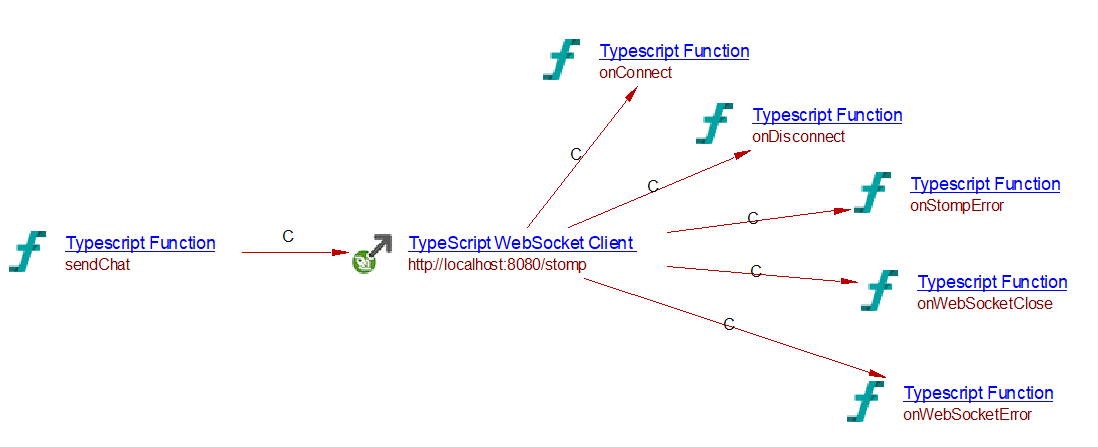
When analyzing the following file
stomp-client.ts
import { Client } from '@stomp/stompjs';
import SockJS from 'sockjs-client';

let chatSub = null;

// Client docs: https://stomp-js.github.io/api-docs/latest/classes/Client.html
const client = new Client({
  // Use webSocketFactory (NOT brokerURL) when going through SockJS.
  // It must return a WebSocket-like object synchronously; SockJS uses http(s)://
  webSocketFactory: () => new SockJS('http://localhost:8080/stomp'),

  connectHeaders: {
    // login: 'guest', passcode: 'guest',
  },

  // Client.debug — verbose frame logging; remove in production
  debug: (msg) => console.debug('[STOMP]', msg),

  // Client.reconnectDelay — 0 disables automatic reconnect
  reconnectDelay: 5000,
  heartbeatIncoming: 10000,
  heartbeatOutgoing: 10000,

  // Fired after the CONNECTED frame. Always (re)subscribe here so that
  // subscriptions are restored after an automatic reconnect.
  onConnect: (frame) => {
    console.log('Connected:', frame.headers['server']);

    chatSub = client.subscribe(
      '/topic/chat',
      (message) => {
        const payload = JSON.parse(message.body);
        console.log(`${payload.from}: ${payload.text}`);
        // message.ack() / message.nack() if you subscribe with ack: 'client'
      },
      { id: 'chat-sub' } // optional stable subscription id
    );

    sendChat('alice', 'hello from the browser 👋');
  },

  onStompError: (frame) => {
    // Broker-level ERROR frame; connection is about to be closed
    console.error('Broker error:', frame.headers['message'], frame.body);
  },
  onWebSocketError: (evt) => console.error('WebSocket error', evt),
  onWebSocketClose: (evt) => console.warn('WebSocket closed', evt.code),
  onDisconnect: () => console.log('Disconnected (RECEIPT for DISCONNECT)'),
});

export function sendChat(from, text) {
  if (!client.connected) {
    console.warn('Not connected yet');
    return;
  }
  client.publish({
    destination: '/app/chat',
    body: JSON.stringify({ from, text }),
    headers: { 'content-type': 'application/json' },
  });
}

export async function stop() {
  chatSub?.unsubscribe();
  await client.deactivate(); // graceful DISCONNECT + close; stops reconnects
}

client.activate(); // starts connecting and keeps retrying per reconnectDelay
you will get the following result: