Sails.js support for Node.js
Introduction
Sails.js is the MVC framework for Node.js, designed to emulate the familiar MVC pattern of frameworks, with support for the requirements of modern apps: data-driven APIs with a scalable, service-oriented architecture.
Objects
This extension, when Sails.js library is found in the source code, may create the following objects:
| Icon | Description |
|---|---|
 |
NodeJS Get Operation |
 |
NodeJS Post Operation |
 |
NodeJS Put Operation |
 |
NodeJS Delete Operation |
|
NodeJS Patch Operation |
 |
NodeJS Any Operation |
Example
Example application from Sails.js:
Server
Create a server app.js:
var sails = require('sails');

sails.lift({}, function (err) {
  if (err) {
    console.log('Error occurred lifting Sails:', err);
    return;
  }
});
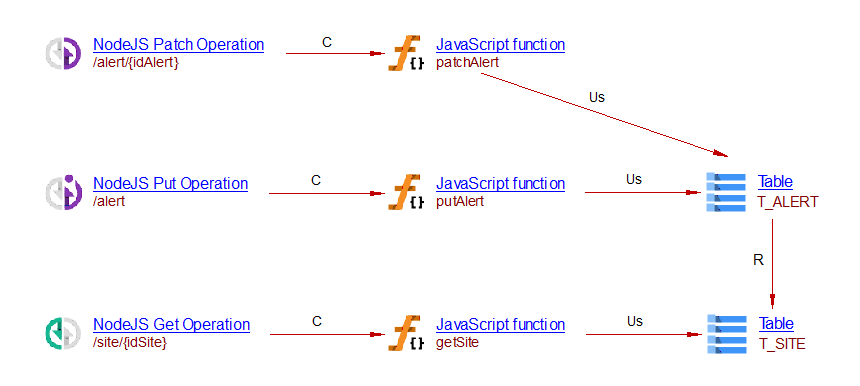
This will give the following result:

Routes
Routes control at config/routes.js:
...
'GET /site/:idSite' : { controller: "Site", action: "getSite", rel: RelServices.REL_ENUM.GET_VIEWED_SITE },
...
'PUT /alert' : { controller: "Alert", action: "putAlert", rel: RelServices.REL_ENUM.PUT_ALERT, profile: ProfileServices.PROFILE_ENUM.OPERER },
...
'PATCH /alert/:idAlert': { controller: 'Alert', action: 'patchAlert',  rel: RelServices.REL_ENUM.PATCH_ALERT,  profile: ProfileServices.PROFILE_ENUM.OPERER },
...
Controller actions
controllers/SiteController.js
...
self.getSite = function (req, res) {
  ...
  var promise = Site.findOne({
    idSite: idSite
  });
  ...
};
...
controllers/AlertController.js
...
self.putAlert = function (req, res) {
  ...
  var promise = Alert.findOne({
    idAlert: idAlert
  });
  ...
};

self.patchAlert = function (req, res) {
  ...
  var promise = Alert.findOne({
    idAlert: idAlert
  });
  ...
};
...
Model definition
models/Site.js
...
self.connection = 'postgresqlServer';

self.tableName = 'T_SITE';

self.attributes = {
  ...
}
...
models/Alert.js
...
self.connection = 'postgresqlServer';

self.tableName = 'T_ALERT';

self.attributes = {
  ...
}
...
Transaction from getSite, putAlert, patchAlert functions to database when using the SQL Analyzer: