SQL Queries - CAST Central Base - SQL Queries on Transactions - How to get the effort complexity for functional artifacts
Purpose of Query
The purpose of this query is to provide the effort complexity for technical artifacts.
This view in TCC provides this information as well
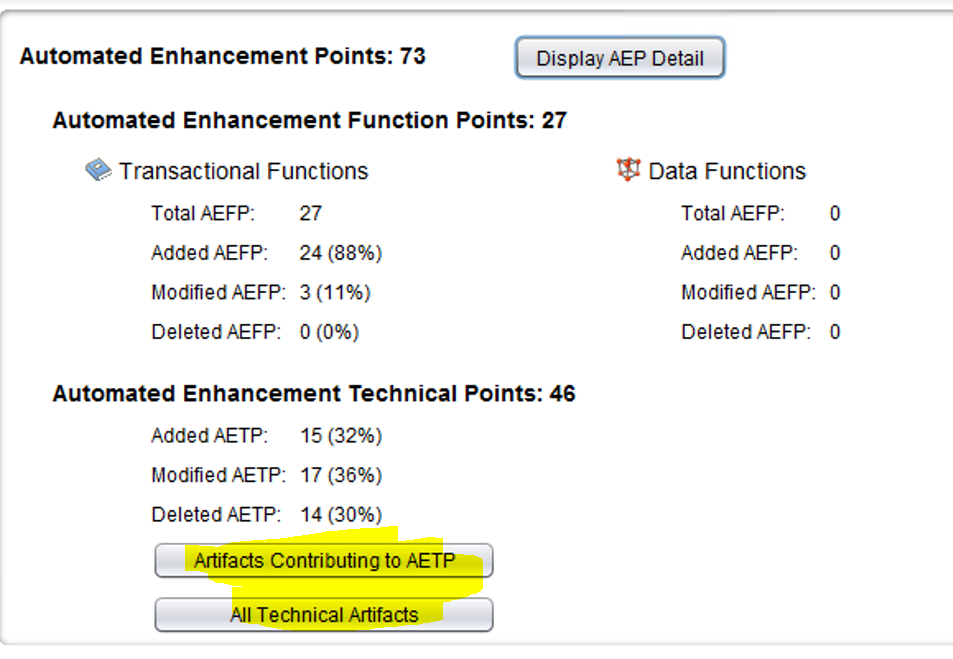
Here’s more information on this topic in the documentation: TCC - Enhancement node - AEP Details
Applicable CAST Version
| Release | Yes/No |
|---|---|
| 8.3.x | ✅ |
| 8.2.x | ✅ |
Applicable RDBMS
| RDBMS | Yes/No |
|---|---|
| Oracle Server | ❓ |
| Microsoft SQL Server | ❓ |
| CSS3 | ✅ |
| CSS2 | ✅ |
Query for CSS
This query requires a snapshot_id which can be obtained here: SQL Queries - CAST Central Base - Queries on snapshots - How to get the ID and name of a snapshot for a given application
SELECT          L.PREVIOUS_OBJECT_ID               AS Transaction_id       ,
                DTR.object_name                    AS transaction_name     ,
                DTR.object_full_name               AS Transaction_full_name,
                OI.OBJECT_ID                       AS child_id             ,
                dob.object_name                    AS child_name           ,
                dob.object_full_name               AS child_full_name      ,
                COALESCE(MR2.METRIC_NUM_VALUE, -1) AS EC
FROM            DSS_OBJECT_INFO OI
                JOIN dss_objects dob
                ON              dob.object_id = OI.OBJECT_ID
                LEFT OUTER JOIN
                                ( SELECT OBJECT_ID ,
                                        METRIC_NUM_VALUE
                                FROM    DSS_METRIC_RESULTS
                                WHERE   METRIC_ID IN ( 10351,
                                                      10352 ,
                                                      10353 ,
                                                      10354 )
                                AND     METRIC_VALUE_INDEX =1
                                AND     SNAPSHOT_ID        = <snapshot_id>
                                )
                                MR2
                ON              OI.OBJECT_ID = MR2.OBJECT_ID ,
                                FP_LINK_INFO L
                JOIN dss_objects DTR
                ON              DTR.object_id = L.previous_object_id
WHERE           L.SNAPSHOT_ID                 = <snapshot_id>
AND             L.LINK_TYPE_ID BETWEEN 11002 AND             11006
AND             OI.OBJECT_ID   = L.NEXT_OBJECT_ID
AND             OI.SNAPSHOT_ID = L.SNAPSHOT_ID
Query result example
2828745;"<transaction_name>";"<transaction_full_name>";1714107;"<child_name>";"<child_full_name";-1
Query result interpretation
The result shows the id and name of the transaction and technical artifact as well as the effort complexity
Query for Oracle
Enter the SQL query
Query result example
Query result interpretation
Query for SQL server
Enter the SQL query
Query result example
Query result interpretation
Notes/comments
Ticket # 26099
Related Pages